
6. May 2026
Heat Pump Anti‑Freeze Valve Guide | Frost Protection Explained
Learn how a heat pump anti‑freeze valve works, why it’s essential for frost protection, and how to protect your system from freezing damage.
If you own or are installing an air source heat pump (ASHP), protecting it from freezing temperatures is essential—especially in the UK climate. One small but critical component that often gets overlooked is the anti‑freeze valve, also known as a frost protection valve.
In this guide, we’ll explain everything you need to know about heat pump anti‑freeze valves, including how they work, why they’re important, and whether your system needs one.
✅ What Is a Heat Pump Anti‑Freeze Valve?
A heat pump anti‑freeze valve is a mechanical safety device designed to protect your heating system from freezing.
It’s installed on the external pipework of a heat pump system—typically the flow and return pipes—where cold weather poses the biggest risk.
Its main function is to:
- Prevent water inside pipes from freezing
- Protect components like pipes, valves, and heat exchangers
- Reduce the risk of costly system damage
When water freezes, it expands and can crack pipes or fittings, leading to leaks or complete system failure.
⚙️ How Does an Anti‑Freeze Valve Work?
Heat pump anti‑freeze valves are thermostatic, meaning they react automatically to water temperature changes.
🔧 Step-by-step operation:
- Temperature drops to ~3°C
The valve senses the cold water temperature and activates. - Valve opens automatically
A small amount of system water is released (drained out). - Freezing is prevented
Removing the cold water reduces the risk of ice forming in the pipework. - Temperature rises above ~4°C
The valve closes again, stopping the discharge.
👉 This process is fully automatic and does not require electricity, making it reliable during power cuts.
❄️ Why Are Anti‑Freeze Valves Important for Heat Pumps?
Modern heat pumps are highly efficient—but they are also vulnerable to freezing, especially:
- External pipework
- Outdoor units
- Systems left unused or without circulation
When freezing occurs, it can lead to:
- 🚫 Blocked flow
- ❗ System shutdown
- 💧 Leaks when ice melts
- 💸 Expensive repairs if Refrigerant Gas leaks in the cracked condenser plate
Frozen water expands inside pipes, which can crack components and cause long-term damage.
⭐ Benefits of Installing an Anti‑Freeze Valve
1. Protects Your Heat Pump System
Prevents ice formation and safeguards expensive components.
2. Works During Power Failures
Unlike electronic frost protection, anti‑freeze valves operate mechanically—even when the system has no power.
3. Improves System Reliability
Helps keep your heating running during extreme cold conditions.
4. Eliminates the Need for Glycol
Many systems use valves instead of chemical antifreeze fluids, which can:
- Reduce maintenance
- Improve heat transfer efficiency
- Lower environmental impact
⚖️ Anti‑Freeze Valves vs Glycol: Which Is Better?
When protecting a heat pump from freezing, there are two main options:
🔹 Anti‑Freeze Valves (Mechanical Solution)
- Automatically drains water at low temperatures
- Simple and low maintenance
- No chemicals required
🔹 Glycol (Chemical Solution)
- Lowers the freezing point of the fluid
- Requires regular maintenance
- Can reduce system efficiency
👉 Many installers choose valves for efficiency and simplicity, but the best solution depends on system design and location.
🔧 Do You Still Need an Anti‑Freeze Valve If the Heat Pump Has Built‑In Frost Protection?
Modern heat pumps are designed with built‑in frost protection, using circulation pumps and defrost cycles to prevent freezing during normal operation. However, these systems rely on electricity to function. In the event of a power outage, this protection is lost, leaving external pipework and components vulnerable to freezing. Industry best practice and MCS‑aligned guidance therefore recommend considering a backup frost protection method, such as an anti‑freeze valve or glycol, particularly for air source heat pumps with outdoor pipework. This ensures the system remains protected even in extreme conditions or unexpected power failures.
📍 Where Should Anti‑Freeze Valves Be Installed?
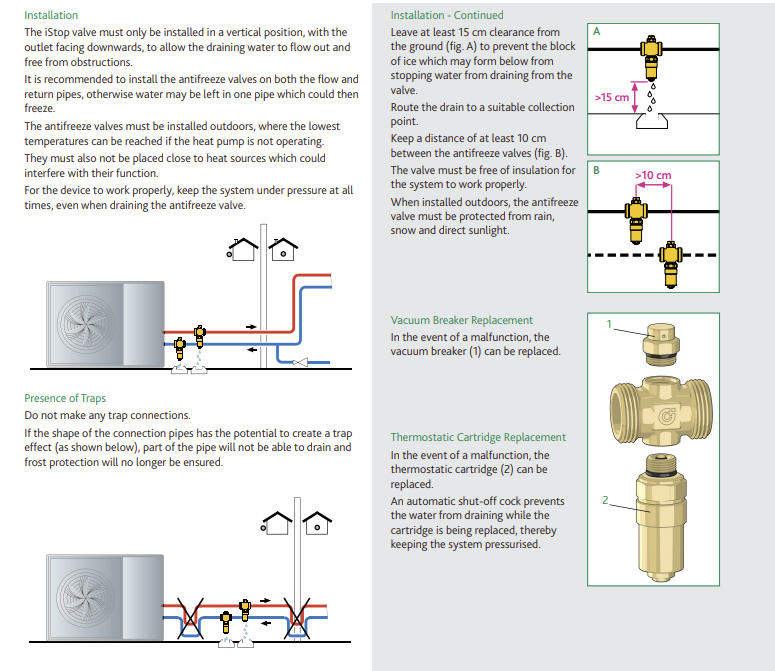
For maximum effectiveness, anti‑freeze valves should be installed:
- On external pipework
- On both flow and return connections
- At the lowest point in the pipe system
Correct installation ensures proper drainage and prevents trapped water from freezing.
⚠️ Are There Any Downsides?
While anti‑freeze valves are highly effective, there are a few considerations:
- They release water when activated
- The system may need refilling and bleeding afterward
- Activation typically occurs only in extreme cold or fault conditions
They are best used as a backup protection method, alongside proper insulation and system design.