 Heat Pump Energy

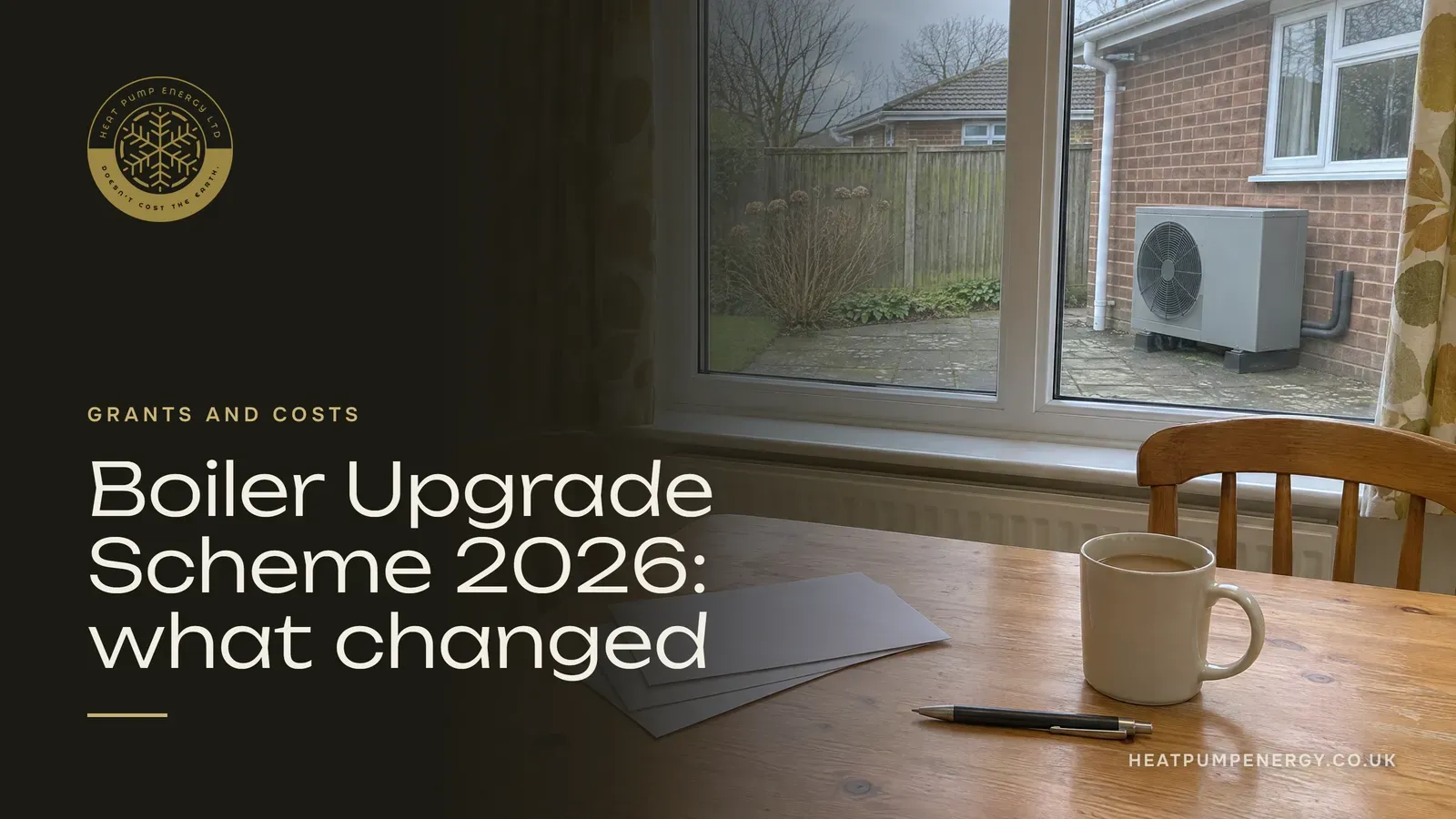
If you've been looking up the Boiler Upgrade Scheme 2026 rules and come away more confused than when you started, you're not alone, because the scheme changed twice this year. From 28 April, you no longer need an EPC to apply, air-to-air heat pumps qualify for £2,500, your installer has to take the grant off your bill upfront by law, and the scheme now runs to 2030. Then from 21 July, off-grid homes moving away from oil or LPG became able to get £9,000 instead of £7,500.
For most homes in Doncaster the headline number hasn't moved at all, and swapping a gas boiler for an air source heat pump still earns you £7,500. What has changed is who can apply, what you need to show and how the money reaches you, and those are the bits worth understanding before you get a quote. We checked everything below against the amending regulations (SI 2026/390), Ofgem's homeowner guidance (v5.1, July 2026) and the government's consultation response of November 2025, all read on 19 October 2026. If you only want the grant amounts set out home by home, our heat pump grants page has them.
The Boiler Upgrade Scheme 2026 changes, one by one
Seven things changed in all, and it's easiest to take them in the order they arrived:
- An EPC is no longer needed to apply (28 April), so a valid Energy Performance Certificate isn't a condition of the grant any more.
- Air-to-air heat pumps got their own £2,500 grant (28 April), though only for homes.
- Taking the grant off your bill upfront became a legal duty (28 April), which means your installer has to deduct it from both your quote and your invoice.
- Identity checks got tighter (28 April). As well as asking for your consent, Ofgem now checks who you are before an application counts.
- Other heating can now sit alongside the heat pump (28 April), as long as it doesn't burn fossil fuel.
- The scheme was extended to 2030 (28 April), two years longer than before.
- Off-grid homes giving up oil or LPG can get £9,000 (21 July), as long as the application is properly made on or before 31 March 2027.
The rest of this page goes through what each of those means for you in practice. The £9,000 rate has a guide of its own, because there's a trap hidden in its rules that's easy to miss, so if you heat with oil or LPG, read our guide to the £9,000 grant as well.
Do I still need an EPC to get the grant?
No, you haven't needed one since 28 April 2026, when the amending regulations removed the requirement for a property to have a valid Energy Performance Certificate.
That doesn't mean the certificate has vanished from the process, though. The government went for what it calls a hybrid model, which works like this:
- If your home has a valid EPC, your installer still puts its reference number on the application.
- If it doesn't, the installer sends other evidence instead. Ofgem's examples are a utility bill or fuel receipt, photographs of the heating system you have now, and the number of an expired EPC if there is one, and you're expected to help gather it.
This is actually the second time the EPC rule has been loosened. Before May 2024, the certificate also had to be free of any outstanding recommendation for loft or cavity wall insulation. That condition went first, and in 2026 the need for a certificate at all went with it.
The people this helps most are those whose certificate has quietly run out. An EPC lasts ten years, so if your house was last sold or let in 2015, there may be nothing valid on the register, and in the past that meant paying for a fresh assessment before anyone could apply for the grant. Now a recent bill and a few photos can do the same job. You can still get a new EPC if you'd like one, and it's a useful record of how your home performs, but it no longer stands between you and the grant.
Is the Boiler Upgrade Scheme ending?
Not on the current rules. The 2026 regulations swapped every mention of 2028 for 2030, so the scheme is now set to run to 2030, with funding years listed up to the one starting 1 April 2029. Before April, it had been due to close in 2028.
What about the reports of cuts?
In October 2026, newspapers reported that ministers were looking at taking money out of the scheme's budget to help pay for defence. The government said it would set out its plans this autumn, with the Budget due on 28 October. When we checked on 19 October, nothing official had changed: the grant values on GOV.UK were still £7,500, £9,000 and £2,500, and the regulations still ran to 2030.
We won't guess at what happens next, because nobody outside government knows. What we can explain is how the scheme works today. The grant is tied to an application your installer makes for your property, and the £9,000 rate depends on when that application is properly made, so pencilling a date in your diary doesn't hold a grant for you. If you've been meaning to look into a heat pump, a survey and a quote are what turn the idea into something that can actually be applied for.
Who can get the £2,500 air-to-air grant?
An air-to-air system blows warm air into a room, instead of heating water for your radiators or underfloor pipes. Since 28 April 2026 the Boiler Upgrade Scheme has paid £2,500 towards one, and the grant notice sets it at that figure regardless of how your home is heated now, be it gas, oil, LPG or electric.
There are two limits to know about. Air-to-air heat pumps only qualify in homes, so business and other non-residential buildings are out. And the scheme still pays one grant per property, which matters more here than anywhere else, because Ofgem treats an earlier publicly funded low-carbon heating install at an address as a usual bar to a second one. If you take £2,500 for air-to-air now, expect it to rule out the £7,500 for an air-to-water system later. That's the part we'd want anyone to think hard about, so decide what you want the system to do, including how you'll heat your water, before you pick which grant to use.
How does the upfront discount change what you pay?
The grant has always been paid to the installer and never to you. Before 28 April 2026, though, the rules didn't say how it had to show up on your bill. Now they do, and it's a legal requirement: your installer must deduct the grant from your quote and your final invoice, and can't charge you that sum or take it from you.
The government explained why in its consultation response. Taking the grant off upfront cuts the risk of a customer paying in full and never seeing the discount, particularly if an installer goes into liquidation between doing the work and being paid. So your grant is protected before you hand any money over, which is how it should always have worked.
It does give you one small new job. After the install, Ofgem asks you to confirm that you received the discount. Our £9,000 grant guide shows what the discount should look like on paper, and it looks the same whichever grant level you're getting.
What will Ofgem ask me to do?
Your installer still runs the application, and you can't apply for it yourself. But Ofgem, or MCS on its behalf, will get in touch with you directly at three points. It helps to know they're coming and that they're genuine, because an unexpected message asking for ID can understandably feel a bit suspicious:
- When your installer applies, Ofgem contacts you to confirm you agree to the application and to check who you are. It may use an identity verification service, and it can ask for documents such as a passport, a driving licence, or a recent utility bill or bank statement.
- After the install, you'll be asked to confirm that you got the grant as an upfront discount.
- Once the grant has been claimed, MCS may email you, or ring from 0333 103 8198, for a short routine check on Ofgem's behalf, which Ofgem describes as a normal quality-assurance step.
Do reply quickly when they get in touch. Ofgem doesn't treat an application as properly made until your consent and identity check are done, and that date is what decides which grant rate you get.
Can a heat pump now run alongside other heating?
Yes, within limits. Ofgem's 2026 guidance lets a grant-funded heat pump be installed alongside other heating appliances, as long as none of them burns fossil fuel. The heat pump still has to be sized to cover your home's full space heating demand on its own, so anything else you keep is there as an extra, and the heat pump has to be able to manage without it.
The other half of that rule hasn't moved: any existing gas, oil or LPG heating system has to be fully replaced. The guidance does spell out which parts of an old system can stay, though, so a new heat pump doesn't automatically mean ripping out pipework that still does its job. Which parts stay in your home is something the survey decides, room by room.
Heat batteries are on the way, but not yet
In November 2025 the government said it would pay £2,500 towards heat batteries, which store heat made from electricity and let it out when you need it. There was a condition attached: product, design and installation standards have to be in force first, so people buying them get the same protection as heat pump customers. It expected applications to open some time in 2026/27.
Heat batteries weren't in the grant notice of 21 July 2026, so until a new notice lists them, treat that grant as planned and not yet available. The government has also said that where a heat battery only tops up hot water alongside a heat pump, the grant follows the heat pump, so that home would get the heat pump grant instead of £2,500.
What stayed the same?
With so much talk about what's new, it's easy to lose sight of the rules that didn't move at all:
- The scheme is still for buildings that already exist, in England and Wales.
- £7,500 is still the standard grant for a ground source or air source heat pump.
- There's still one grant per property, and nothing for a hybrid system that keeps a boiler.
- Most new builds are still excluded, and so is social housing, shared ownership included.
- Your installer must be MCS certified and a member of an approved consumer code, and it's the installer who applies.
What the 2026 changes mean for a Doncaster home
Doncaster is largely a mains gas town, so for the typical house here the money hasn't changed and the grant is still worth £7,500 if you go for air source. The changes that matter locally are the practical ones. A home without a current EPC isn't held up any more, the discount is guaranteed in law before you pay, and the scheme has a longer future than it had at the start of the year, at least on the rules as they stood when we checked.
Mark's installs are certified under Ample's MCS certification, and Ample (the trading name of Fornax Energy Ltd) applies for the grant, so you won't be filling in the grant forms yourself. The online estimate tells you which grant your home qualifies for and takes it off the figure you see. After that, Mark comes out to do a LiDAR scan of the house and a heat loss calculation worked out room by room, which the heat pumps page explains properly. And if you'd rather talk it all through first, give Mark a ring on 07725 541383 any weekday up to 5pm.