 Heat Pump Energy


Probably some, but rarely all. Heat pump radiators run cooler than boiler ones, so each one gives out less heat. Where a radiator is still big enough for its room at the lower temperature, it stays. Where it is not, it is swapped for a larger one. A room-by-room heat loss survey decides which is which.
In the government's Electrification of Heat project, 93% of homes that had a heat pump fitted needed at least one radiator replaced, according to the project's survey and install report published in December 2022. Mark's own rule of thumb, which his online estimate uses, is that at a 45°C flow temperature about a quarter of a home's radiators usually need changing. The survey then counts them properly. The rest of this guide explains why heat pump radiators are a question at all, and what decides the answer for each room.
Why does a heat pump need bigger radiators?
Because of the temperature of the water. Vaillant, one of the big makers of both, puts a gas boiler's usual flow temperature at 60 to 80°C and a heat pump's at around 35 to 55°C, and Mark's designs start from 45°C.
A radiator gives out heat according to how much warmer it is than the room. Halve that difference and you do not quite halve the output: you lose more than half. Cooler water means a cooler radiator, and a cooler radiator heats the room more slowly.
The heat pump could make hotter water, but that costs efficiency, and efficiency is the whole point. A heat pump's efficiency falls as its water temperature rises, so one that runs hot to make up for small radiators can end up costing more to run than the boiler it replaced. A bigger radiator lets the system run cool and cheap.
How much heat does a radiator lose at heat pump temperatures?
Radiator outputs in the UK are usually quoted at a standard condition called ΔT50: the average water temperature is 50°C above the room. That is roughly a radiator fed at 75°C and coming back at 65°C in a 20°C room, which is boiler territory.
Manufacturers publish factors for other conditions. Stelrad's radiator book, February 2020 edition, gives these, and its instruction is simple: multiply the ΔT50 output by the factor to get the output at the lower temperature.
- ΔT50, boiler conditions: factor 1.000.
- ΔT40: 0.748.
- ΔT35, water averaging 55°C in a 20°C room: 0.629.
- ΔT30, water averaging 50°C: 0.515.
- ΔT25, water averaging 45°C: 0.406.
Take a radiator rated at 1,000 watts at ΔT50. With water averaging 45°C in a 20°C room, it gives out about 406 watts, roughly 40% of its label figure. That is the scale of the change, and it is why a radiator that kept a room warm for twenty years can fall short on a heat pump.
Which radiators need changing, and which can stay?
The radiator is only half the sum. The other half is the room. A radiator only needs changing if, at the design temperature, it cannot replace the heat the room loses on a cold day.
That is why the survey matters more than any rule of thumb. Mark scans the house with LiDAR to build an accurate floor plan, and the heat loss of each room is worked out from it: its size, its outside walls, its windows and how well it is insulated. Each room's heat loss is then set against what its existing radiator gives out at the design flow temperature. Where the radiator falls short, it is upsized. Where it copes, it stays. The process is shown step by step on the heat pumps page.
Two neighbouring houses can come out very differently. A cold north-facing bedroom with two outside walls may need a larger radiator, while a small inner hall in the same house manages with what it has. Our page on heat pumps in Rotherham makes the same point about two three-bed semis on one street.
A worked example: one room
Here is how the sum runs for a single room. The numbers are an illustration, not a measured house.
Say the survey finds a room loses 600 watts on a design cold day, and its radiator is rated at 1,000 watts at ΔT50. At heat pump temperatures, with the water averaging 45°C and the room at 20°C (a round number to keep the sum simple), that radiator gives about 406 watts. It falls short by almost 200 watts, so the room would never quite reach temperature in the coldest weather.
Stelrad's method for choosing the replacement is to divide the heat the room needs by the factor: 600 ÷ 0.406 is about 1,480 watts. So the new radiator needs a ΔT50 rating of at least 1,480 watts, and the design would pick the nearest standard size above that. Run the same sum on every room and you have the radiator schedule for the house.
Why do bathrooms and bedrooms come out differently?
Because they are designed to different temperatures. The MCS heat load calculator takes its room temperatures from the CIBSE Domestic Heating Design Guide: 21°C for living rooms, 22°C for bathrooms and shower rooms, and, in most older homes, 18°C for bedrooms, halls and kitchens.
That changes the radiator sum. A radiator's output depends on how much warmer the water is than the room, so a bedroom kept at 18°C gets a little more from the same radiator, and a bathroom at 22°C gets less. Bathrooms are often the hardest rooms to get right on a heat pump, which is why towel rails are checked as carefully as radiators. Sometimes the answer is a larger rail, sometimes a rail plus a small radiator, and sometimes underfloor heating.
What are the options besides a bigger radiator?
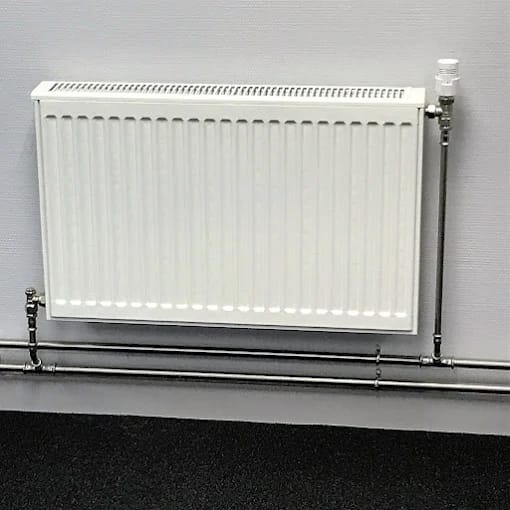
A larger radiator does not have to mean a wider one. Panel radiators come in single, double and triple-panel types, and a deeper radiator gives out more heat from the same stretch of wall. Often the new radiator fits the same space as the old one.
Underfloor heating is the other route. It warms a whole floor gently, so it works at the low water temperatures a heat pump likes, and many homes mix the two: underfloor heating downstairs, radiators upstairs. Underfloor heating can be part of a heat pump install with Mark, and he repairs existing systems too.
The third option is to reduce the heat the room needs. Loft insulation, cavity wall insulation and better glazing all cut a room's heat loss, which can bring an existing radiator back within range. In the Electrification of Heat project, 15% of homes had energy efficiency work done as part of their install, most often loft insulation.
Will my pipework need changing too?
Sometimes. A heat pump usually runs with a smaller gap between the water going out and the water coming back than a boiler does. To carry the same amount of heat with a smaller temperature drop, more water has to flow round the system. Narrow pipes, such as the 8mm or 10mm microbore found in some homes, can limit that flow.
That does not mean replacing every pipe in the house. It means checking the pipe sizes on the routes that matter, as part of the same survey that looks at the radiators. Anything that needs changing goes into the proposal, so it is costed before you decide, not discovered on the day.
Do heat pump radiators feel different?
Yes, and it is worth knowing before the first winter. Mitsubishi Electric's own guidance for Ecodan owners is that radiators will not feel as hot as they did on a boiler, and that this is not a problem, because they are still warmer than the room. The system also responds more slowly when you change the temperature, so it pays to make a change and leave it rather than keep adjusting.
The other difference is rhythm. A heat pump is meant to run gently for long spells and hold the house at a steady temperature, rather than heat it up fast from cold. Warm rather than hot radiators, on for longer, is what a heat pump working well feels like. The test of whether it is working is the room temperature, not the feel of the radiator.
How do I find out about my own radiators?
Start with the online estimate. It estimates how many radiators your home has and how many are likely to need changing, says plainly that this is an estimate, and includes them in the figure. The survey then replaces the estimate with a count: every room measured, every radiator checked against its room's heat loss.
If you would rather ask first, Mark takes calls on 07725 541383, Monday to Friday until 5pm.